Souparnika Export Enterprises is a family-owned cashew proprietorship registered in Kerala, India. It is run end-to-end by V. Gopala Pillai — Raju to the trade — who has spent nearly three decades inside Kollam's cashew quarter.
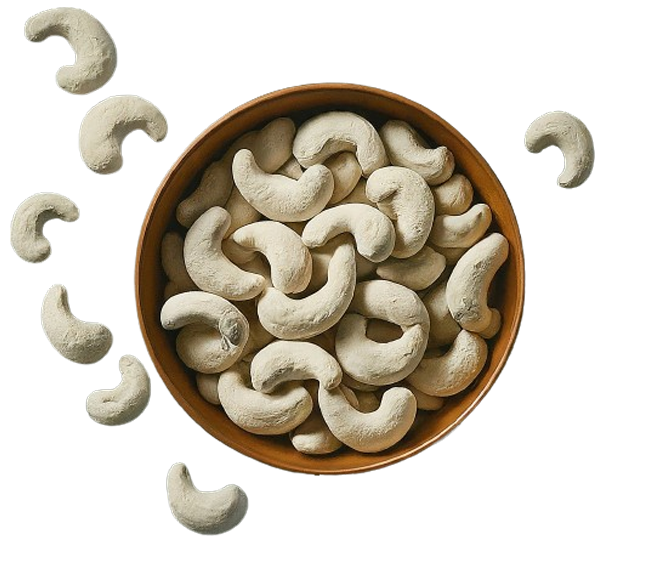 Plate · A Souparnika standing lot
Raju started inside other people's factories in the 1990s — first as a cutter's assistant, then as a grading supervisor, then as a floor manager. By 2008 he had seen every variable that decides whether a Kollam cashew house wins or loses money, and he opened Souparnika to run a smaller, tighter version of his own.
Today the proprietor still walks the floor every morning, signs off on the grading-table samples himself, and personally reads every RFQ that comes through seeinfo@souparnikaexim.com. The house remains deliberately small — single proprietor, family supervision, hand-trained sorters — so that the standard never drifts.
V. Gopala Pillai (Raju) begins working inside Kollam's cashew quarter — first on the cutting floor, then in grading, then in floor supervision across multiple processing houses.
The proprietorship is established at Decent Junction, Kollam — a deliberately small operation, run as a family house, with Raju on the floor every day.
Souparnika is registered under India's GST regime (32 · · · 1ZV), formalising the proprietorship under the new indirect-tax framework.
The standing book settles around the Gulf — UAE, KSA, Qatar, Oman — with growing private-label runs into Europe and Southeast Asia.
Souparnika ships across nine industry-standard grades — W180 through W450, scorched wholes, splits, four piece classes, and bulk RCN — every consignment passing through hands the proprietor has personally trained.
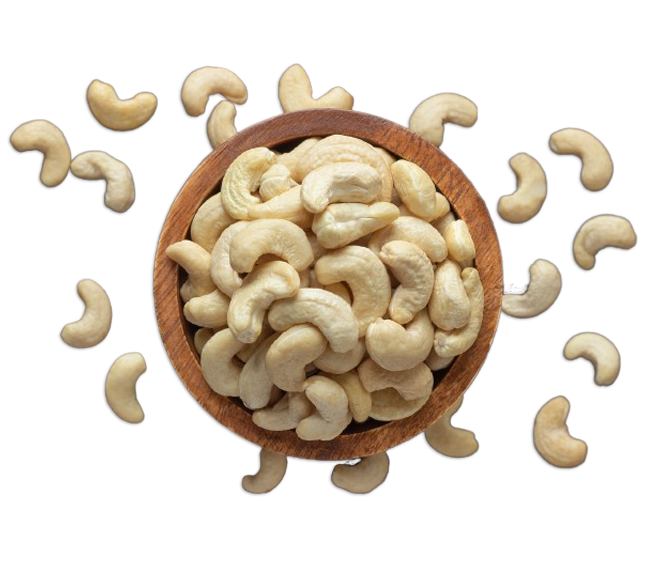 Plate · Hand-graded for export
Kollam, on the Kerala coast, processes around 90% of India's export-grade cashew. The Cashew Export Promotion Council of India was established here in 1955, and the city remains the single largest hub for processed cashew on earth.
The reason is the labour. Cashew is the one major nut where the shelling step cannot be fully mechanised — releasing the kernel whole still requires a calibrated human hand on a pedal-operated cutter. Kollam has spent three generations training that hand, and it is the reason Souparnika can promise a 90%-plus whole-kernel yield on its W-grades.
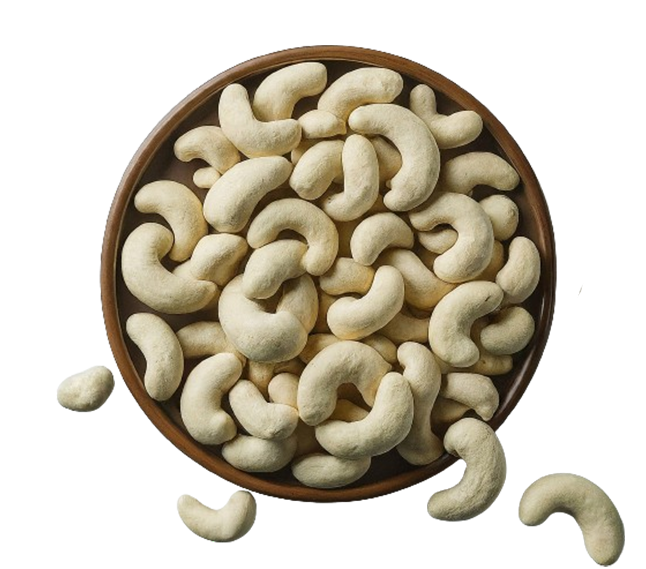 Plate · Hand-grading, Kollam
Souparnika supports a workforce of over 2,000 people, with a stated commitment to women's employment and sustainable economic growth in the Kollam belt. Cashew processing is one of Kerala's largest sources of women's industrial work, and the house treats that responsibility as part of its product.
It is also why Souparnika holds a SMETA ethical-trade audit — so the fairness of the work behind the kernel is documented, not just claimed.